A New Development in Paleo Hebrew Studies
By M. Dawson, October 2026
A Discovery on the Hebrew Letter Tav ת
If you’ve studied Original Hebrew (also known as Paleo Hebrew and Ancient Hebrew), you know that each letter of a Biblical Hebrew word has a meaning that contributes to the overall meaning of the word. This is a Basic Principle of our studies. However, as we pointed out in our video on the letter Tav, there are words containing the letter Tav that have the same meaning whether or not a Tav is present.
Examples:
- Et (spelled Ayin-Tav עת) means time. Time is a type of observation which is pictured in the letter ע Ayin – no Tav needed. Strong’s #H6256
- Resheet (spelled Resh-Alef-Shin-Tav ראשת) means beginning. Take away the Tav and you have a word which still means beginning. Strong’s #H7225, #H7218
- Tannin (spelled Tav-Nachash-Nachash תננ) is the word for serpent. A serpent is pictured in the two Nachash ננ letters – no Tav needed. Strong’s #H8577
These are three examples, but we’ve run across numerous examples in our studies. It’s as if the letter Tav can be cancelled out in order to isolate the letters that contribute meanings to a word.
Does this mean the letter Tav has no meaning? No – this is actually what Father designed the letter Tav to do. Tav is a mark. We know this because in Hebrew, the word tav means mark.
Since Tav is a mark and a letter is a type of mark, the letter Tav can simply mean letter, mark of, or sign of.
Here’s a simple illustration. The Hebrew word for house is bayit, and in many Bible verses it’s often reduced to just the letters “Beyt-Tav.” By the letters, the meaning of the Hebrew word for house is literally “the letter beyt = house.”
| בת (bet) = house | |||
| ת | ב | ||
| the letter/sign of | beyt | = | house |
This “Tav Principle” as we’ll call it appears to be a formula of sorts that GOD our Father embedded in the language and alphabet HE created. It’s one of the many reasons we say the Original Hebrew alphabet is His creation, not man’s.
The Tav Principle
When you see a Tav in a Biblical Hebrew word, it can mean “letter” or “sign of”
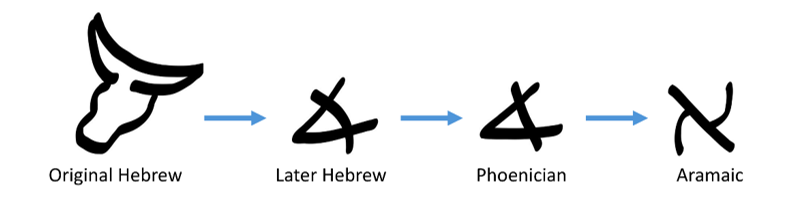
I believe this “formula” is one way HE preserved letter-meanings in His ancient language, knowing that one day people would change His original symbols into characters which lack any pictographic meaning. Alef, as many know, went from being a picture of a bull into an Aramiac character that bears little resemblance to its forebear.
As mentioned earlier, the Tav Principle applies not just in words where there is only a single letter plus a Tav, but in longer words with a Tav.
From the Hebrew word resheet, we see that when the signs “Resh-Shin-Alef” are grouped together, it means beginning.
| ראשת (resheet) = beginning | |||
| ת | ראש | ||
| the sign of | Resh-Alef-Shin | = | beginning |
This discovery about the letter Tav has been and remains extremely helpful in finding the meanings of letters and words in the Original Hebrew script, and it’s something I’ve used for years in my studies.
A Discovery on the Hebrew Letter Alef א
In May 2026, Father led me to take a look at the Hebrew word for sign and apply the Tav Principle. I hadn’t done it yet since when I discovered the Tav Principle, I was making my way through the Hebrew dictionary in alphabetical order and had already gone past Alef.
When applying the Tav Principle to the Hebrew word for sign, I found that the letter Alef can work just like a Tav in root words.
Here’s the “math” on that.
The word for sign in Hebrew is ot (Strong’s #H226). If you look it up in a Hebrew dictionary, you’ll see it spelled Alef-Vav-Tav, but the Vav there is an added vowel letter that’s not original to the word. It’s what scholars call a “matres lectionis” – a letter added as a vowel to help with pronunciation. Since we study the meanings of words as displayed by the original pictographic letters, one of our first steps is to try to remove any letters added by scribes. Added vowel letters aren’t always easy to identify, but the word sign (ot) is thankfully preserved in several places in Scripture without the Vav. (Genesis 1:14, Exodus 4:8, Exodus 12:13, et al.)
The original spelling of ot (sign) in Hebrew is Alef-Tav.
Using the Tav Principle, this means that the letter Alef = sign.
| את (ot) = sign | |||
| ת | א | ||
| the letter/sign of | Alef | = | sign |
If you look up the definition of sign, you’ll see it’s a symbol, a mark, an indicator, and evidence. As a mark and symbol, a sign perfectly describes a letter.
When I saw this, I realized that not only is there a Tav Principle, there’s also an Alef Principle in which Alef functions the same way as Tav.
The Alef Principle
When you see an Alef in a Biblical Hebrew word, it can mean “letter” or “sign of”
Not only can we use the Tav Principle on the word sign (ot) to determine that the letter Alef = a sign, we can use the Alef Principle to determine that the letter Tav = a sign. This is something we already understood since, as mentioned earlier, Tav is a Hebrew word that means mark and a mark is defined as a type of sign. But in the word ot (sign), we essentially found a proof for that understanding.
| את (ot) = sign | |||
| ת | א | ||
| Tav | letter | = | sign |
Since Alef and Tav can each be used in Hebrew words to simply mean “letter” and “sign of,” we call them Sign Letters.
Sign Letter
A letter that can mean “letter” or “sign of” in a Biblical Hebrew word
Both Alef and Tav can have other meanings in Biblical words, but their use as Sign Letters is quite common. We’ve gone through a few Tav examples already, so let’s take a look at how Alef is used as a Sign Letter.
Gimmel is a picture of a foot, and as a foot is something that is lifted up, the letter Gimmel can mean “lift up” in Hebrew words. Here’s a word spelled Gimmel-Alef in which this meaning of Gimmel is plain:
| גא (ge) = proud | |||
| א | ג | ||
| Letter | Gimmel | = | lifted up |
The letter Hey has the meaning of behold in many Hebrew words and the Hebrew word he, spelled Hey-Alef, unsurprisingly means behold.
| הא (he) = behold | |||
| א | ה | ||
| Letter | Hey | = | behold |
As another example, the letter Quf is a picture of the sun at the horizon, and as the sun bursts forth from the horizon each morning, we see many examples of Quf meaning burst forth in Hebrew words.
Here’s a word spelled Quf-Alef in which this meaning of Quf is plain:
| קא (qa) = vomit | |||
| א | ק | ||
| Letter | Quf | = | a bursting forth |
Words like ge, he, and qa serve to identify meanings of individual letters because they contain only one letter + sign letters. We call these Sign Words.
Sign Words
Words that serve to identify the meanings of Original Hebrew letters because they contain only one letter plus one or more Sign Letters
The Significance of Sign Letters and Sign Words
In the past, we have found the meanings of letters through several means:
- Some meanings are obvious based on a letter’s symbol. For example, the letter Peh is a picture of a mouth and it’s used in many Hebrew words to simply mean mouth.
- Understanding a symbol’s real-life function helps identify letter-meanings. For example, since Peh is a mouth, Father uses it in Hebrew words to mean open and speak.
- The Old Testament contains what we call Corresponding Words – these are Hebrew words which directly correspond to the names of Hebrew letters. For example, there is a word peh in the Bible which means mouth and is translated as open, portion and edge. How Father uses the word peh in the Scriptures helps us understand how HE uses the letter Peh in words.
Corresponding Words
Words that correspond to the name of a Hebrew letter and whose meanings demonstrate the meanings of the corresponding letter
With the discovery of His Sign Letters, we now have an additional way of learning letter-meanings, and as you saw with the words ge, he, and qa, we have a way of verifying meanings we already knew.
The use of Sign Letters as a way of verifying meanings is not surprising when you realize the word sign not only means symbol and mark, but also evidence and proof.